If you’re selling a registered vehicle in Victoria, a Roadworthy Certificate (RWC) is compulsory. You can’t legally transfer registration to the buyer without one — and it must be dated within 30 days of the transfer.
Most sellers don’t think about the RWC until the buyer asks. That’s when the stress starts. Here’s everything you need to know so you’re prepared.
What Is a Roadworthy Certificate?
A Roadworthy Certificate — formally called a Certificate of Roadworthiness — is a document issued by a licensed Vehicle Tester (LVT) confirming that a vehicle meets Victoria’s minimum safety standards at the time of inspection.
It is not a mechanical warranty. It does not mean the vehicle is in perfect condition, or that nothing will fail in future. It means the vehicle passed a defined safety inspection on a specific day. Buyers should understand this distinction too.
When Do You Need an RWC in Victoria?
You need a Roadworthy Certificate when:
- Selling a registered vehicle — the seller must provide an RWC dated within 30 days of the ownership transfer
- Re-registering an unregistered vehicle — required if the vehicle has been unregistered for 3 or more months
- Clearing a VicRoads or Police defect notice — an RWC may be required to lift a serious defect
- Transferring interstate registration — depending on the state of origin and vehicle age
You do not need an RWC for routine servicing, insurance, or most private transfers between immediate family members.
What Gets Inspected?
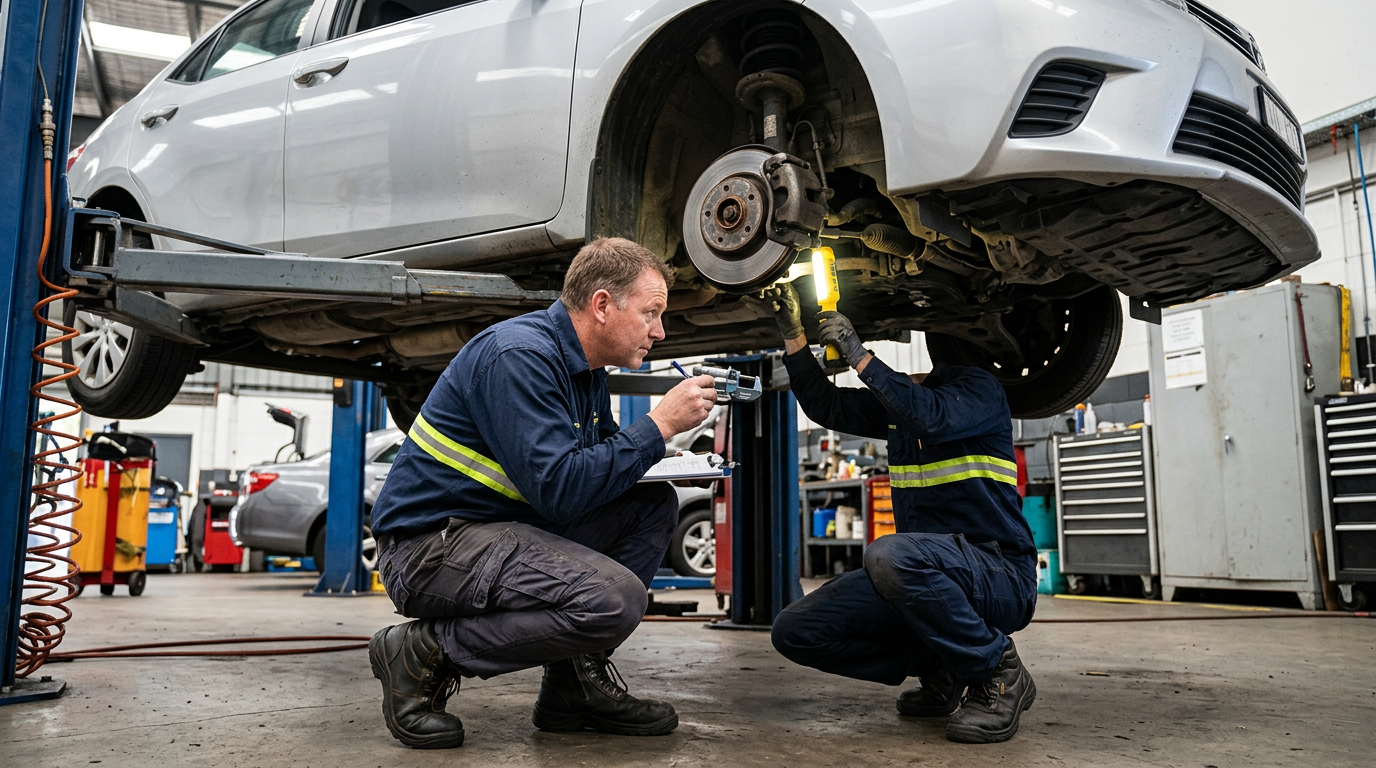
Licensed Vehicle Testers check the following safety-critical systems:
Brakes
Pad and shoe thickness, rotor and drum condition, hydraulic lines and hoses, handbrake effectiveness, ABS warning light operation.
Steering and Suspension
Steering rack or box condition, tie rod ends, ball joints, wheel bearings, shock absorbers and struts, bushings and mounts. Play, wear, and leaks are all assessed.
Tyres and Wheels
Tread depth (minimum 1.5mm across the full tread width), tyre condition — checking for cuts, sidewall bulges, damage, and incorrect fitment. Wheel security and rim condition.
Lighting
All external lights must function correctly — headlights (high and low beam), taillights, brake lights, indicators, hazard lights, reversing lights, and number plate illumination.
Visibility
Windscreen condition — cracks within the driver’s line of sight are a fail. Wiper condition and effectiveness. Mirrors must be present, secure, and adjustable.
Body and Chassis
No sharp edges, structural damage to the chassis or body, or loose panels that present a safety risk. Towbar condition if fitted.
Under-Bonnet and Under-Vehicle
Engine oil and coolant leaks, fuel system condition, exhaust system security and integrity.
Common Reasons Cars Fail an RWC
Based on what we see at BPS Automotive, the most frequent fail items are:
- Worn brake pads — often marginal at the time of inspection
- Cracked windscreen — even minor cracks in the line of sight are a fail
- Tyres at or below the minimum tread depth
- Non-functioning lights — globes, fuses, or wiring
- Worn suspension components — particularly on older vehicles
- Oil or fluid leaks from the engine or transmission
Many of these items are inexpensive to fix. Getting a pre-sale service before booking your RWC can identify and resolve common issues before the formal inspection.
What Happens If Your Car Fails?
You’ll receive an itemised list of the items that need rectification. Once those items are repaired, you book a re-inspection. If we do the repairs at BPS Automotive, the re-inspection is included at no additional charge.
You are not required to have the repairs done at the same workshop that performed the inspection — but having them done in one place saves time and coordination.
How Long Is an RWC Valid?
A Roadworthy Certificate is valid for 30 days from the date of issue, or until the vehicle travels more than 1,000km — whichever comes first. If the vehicle is not transferred within that window, a new inspection is required.
Plan your sale timing around the certificate. Don’t get an RWC done 6 weeks before you list the car.
How Long Does the Inspection Take?
A standard RWC inspection at BPS Automotive takes approximately 45–60 minutes. If minor repairs are required and we have the parts on hand, we can often complete those on the same day.
Book an RWC in Mordialloc
BPS Automotive is a licensed Vehicle Tester providing Roadworthy Certificate inspections in Mordialloc for drivers across Bayside Melbourne — including Mentone, Parkdale, Cheltenham, Chelsea, Carrum, and surrounding suburbs.
Call 03 9588 2992 or book your inspection online.